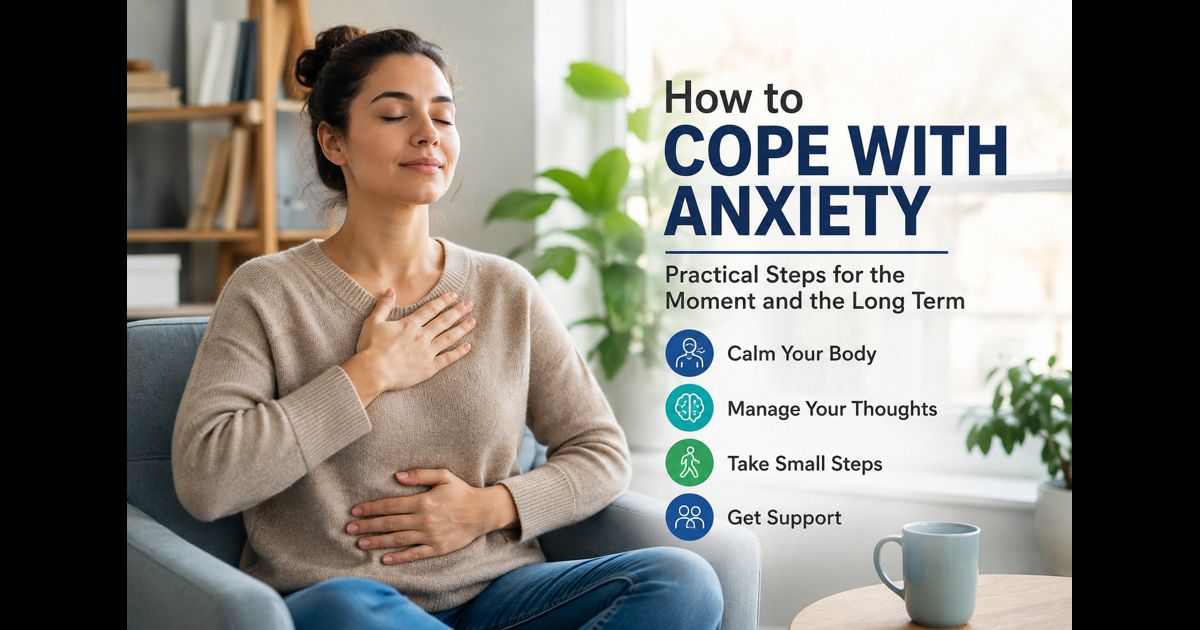
Anxiety can feel like a warning signal that will not switch off. Your heart may race, your breathing may become shallow, your thoughts may jump to the worst possible outcome, and ordinary tasks can suddenly feel harder to manage.
Feeling anxious from time to time is part of being human. Anxiety may arise before an important conversation, a medical appointment, a financial decision, or an unfamiliar situation. It becomes more concerning when it feels persistent, overwhelming, difficult to control, or starts interfering with sleep, work, relationships, school, or daily responsibilities.
Coping does not mean forcing yourself to “calm down” instantly or pretending that nothing is wrong. It means responding in ways that lower immediate distress, reduce avoidance, and make it easier to get appropriate support when anxiety keeps returning.
Start by naming what is happening
When anxiety rises, the body can react as if danger is close. A fast heartbeat, tight muscles, sweating, nausea, dizziness, trembling, and shortness of breath can all be part of that response. These sensations are uncomfortable, but they do not automatically mean that you are failing or losing control.
Try a simple statement:
“I am having an anxious reaction. I can take one small step before deciding what to do next.”
Putting a name to the experience can create a little distance between you and the fear. It also helps separate a feeling from a fact. Anxiety may tell you that a feared outcome is certain, even when you do not yet have evidence that it will happen.
If physical symptoms are new, severe, or different from your usual anxiety—especially chest pain, fainting, serious breathing difficulty, or signs of a medical emergency—seek urgent medical care rather than assuming anxiety is the cause.
Reduce the physical surge first
Trying to solve every worry while your body is in a high-alert state is rarely effective. Begin with a short practice that gives your nervous system a chance to settle.
Slow your exhale
Sit or stand in a position that feels steady. Breathe in gently through your nose, then let the out-breath last slightly longer than the in-breath. Do not force a deep breath if that makes you light-headed.
For example:
- Breathe in gently for about three seconds.
- Breathe out slowly for about four to six seconds.
- Continue for one or two minutes.
The goal is not perfect counting. A slower, comfortable exhale can interrupt rushed breathing and give your attention a single, manageable task.
Use grounding to return to the present
Grounding is useful when your mind is racing ahead or replaying something distressing. Look around and quietly notice:
- Five things you can see
- Four things you can feel physically
- Three things you can hear
- Two things you can smell
- One thing you can taste or appreciate in the moment
You can also press both feet into the floor, hold a cool glass of water, or describe nearby objects in detail. These actions do not erase the worry; they help move attention away from the alarm loop and back to the environment around you.
Move gently
A short walk, a few minutes of stretching, or slowly climbing stairs can release physical tension and redirect excess energy. Choose movement that feels safe and realistic. Intense exercise is not necessary during an anxious moment; the aim is simply to help your body complete some of its stress response.
Separate facts from anxious predictions
Anxiety often speaks in absolute language: “I will mess this up,” “They will judge me,” “I cannot handle this,” or “Something terrible is about to happen.”
Rather than arguing with every thought, ask a few grounded questions:
- What do I know for certain right now?
- What am I predicting?
- Is there another explanation?
- What would I say to someone I care about in this situation?
- What is one useful action I can take today?
For example, “I will definitely lose my job” may become: “I received difficult feedback and feel scared. I can review it, ask clarifying questions, and make a plan for the next conversation.”
This is not false positivity. It is a way to replace a frightening prediction with a more accurate and actionable view.
Shrink the next step
Anxiety can make an entire day feel impossible. Breaking one large problem into a smaller next action can restore a sense of direction.
Instead of “I need to fix everything,” try:
- Send one message.
- Make one appointment.
- Write down three questions.
- Spend ten minutes on one task.
- Take a shower and eat something.
- Ask one trusted person for company.
A small completed action does not solve every problem, but it can reduce helplessness. Repeated avoidance may offer short relief while allowing fear to grow over time. A manageable step toward what matters can build confidence gradually.
Notice patterns without judging yourself
Keeping a brief record can make anxiety easier to understand. You do not need a detailed diary. A few notes can be enough:
- What was happening before anxiety rose?
- What thoughts were most persistent?
- What sensations did you notice?
- What did you do next?
- What helped, even slightly?
Patterns may include poor sleep, too much caffeine, alcohol, conflict, rushing, social pressure, uncertain news, illness, a difficult anniversary, or a particular place or situation. Recognizing a pattern is not about blaming yourself. It gives you information you can use.
For reliable context on evaluating health claims and online advice, see Trust, Accuracy, and Transparency in Online Health Information.
Build a steadier daily foundation
Daily habits cannot cure an anxiety disorder on their own, but they can make anxiety more manageable and support professional treatment.
Protect sleep where possible
Anxiety and sleep problems can reinforce each other. A consistent wake time, a quieter wind-down routine, less late-night screen stimulation, and avoiding caffeine late in the day may help. If insomnia is persistent, discuss it with a healthcare professional rather than relying on sleep aids without guidance.
Eat and drink regularly
Long gaps without food, dehydration, and large amounts of caffeine can make some people feel shaky, restless, or more on edge. Regular meals, water, and attention to how caffeine affects you can be practical starting points. Alcohol may seem calming in the moment but can disrupt sleep and worsen anxiety afterward.
More broadly, nutrition, lifestyle, and daily habits can support both physical health and emotional well-being.
Make room for regular movement
Walking, cycling, strength training, gardening, dancing, or another activity you can repeat may support mood, sleep, and stress management. Start with what fits your current energy and circumstances. Consistency matters more than choosing an ideal routine.
Keep some connection
Anxiety can pull people toward isolation, especially when they feel embarrassed, exhausted, or afraid of being a burden. A short call, a shared meal, a walk with someone, or a support group can make difficult feelings less lonely.
You do not need to explain everything perfectly. You might simply say, “I have been feeling very anxious lately and would appreciate some company.”
Be careful with reassurance loops
Seeking reassurance is understandable. You may repeatedly check your body, reread messages, ask the same question, look up symptoms, or avoid situations that make you uneasy. These actions can briefly reduce fear, but the relief may not last.
When you notice a reassurance loop, pause and ask:
- Have I already gathered enough information to make a reasonable next decision?
- Am I looking for certainty that no one can provide?
- Could I wait ten minutes before checking again?
- What would help me tolerate the uncertainty without acting on it immediately?
This can feel uncomfortable at first. The aim is not to deny a real concern; it is to reduce habits that keep anxiety in control.
Use professional support when anxiety persists
Self-care practices are valuable, but they are not a substitute for assessment or treatment when anxiety is frequent, intense, or disruptive.
Consider speaking with a healthcare professional or licensed mental health professional if anxiety:
- Persists for weeks or becomes harder to manage
- Causes panic attacks or severe physical distress
- Leads you to avoid work, school, travel, social situations, or necessary activities
- Disrupts sleep, concentration, relationships, or eating
- Occurs alongside depression, substance use, trauma symptoms, or compulsive behaviors
- Makes daily life feel unsafe or unmanageable
A clinician can consider whether another medical issue may be contributing and discuss suitable care. Evidence-based options can include cognitive behavioral therapy, other forms of psychotherapy, and medication when appropriate. Treatment should be individualized; do not start, stop, or change prescribed medication without professional guidance.
The National Institute of Mental Health explains that anxiety disorders involve more than occasional worry and can worsen or interfere with daily life without support.
Know when immediate help is needed
If you are thinking about harming yourself, feel unable to stay safe, or are in immediate danger, call emergency services.
In the United States, call or text 988 or use the chat service at the 988 Suicide & Crisis Lifeline. It provides free, confidential support 24 hours a day. If you are outside the United States, contact your local emergency number or a crisis service in your country.
Reaching out during a crisis is a protective step, not an overreaction.
Coping is a practice, not a test
There is no single technique that works the same way for everyone. One person may find breathing exercises helpful, while another may benefit more from movement, structured therapy, less caffeine, or talking with someone they trust.
Choose one practice for anxious moments and one habit that supports you over time. Try them consistently enough to learn what changes. If anxiety continues to narrow your life, professional support can help you regain room to live according to your values rather than your fears.
Frequently Asked Questions
Can anxiety go away on its own?
Occasional anxiety often eases when a stressful situation passes. Persistent or worsening anxiety may need professional support, especially when it affects daily functioning.
What is the fastest way to cope with anxiety?
There is no universal fast fix, but slowing your exhale, grounding yourself in the present, moving gently, and taking one small practical step may reduce immediate intensity.
Does caffeine make anxiety worse?
Caffeine can increase jitteriness, a racing heart, and sleep disruption in some people. Reducing it gradually and observing how you feel can help you decide whether it is contributing.
Is anxiety a sign of weakness?
No. Anxiety is a common human response influenced by many factors, including stress, health, life experiences, and family history. Seeking support is a practical form of self-care.
Can therapy help with anxiety?
Yes. Therapies such as cognitive behavioral therapy can help people understand anxiety patterns, respond differently to fear, and reduce avoidance. A licensed professional can help identify an appropriate approach.