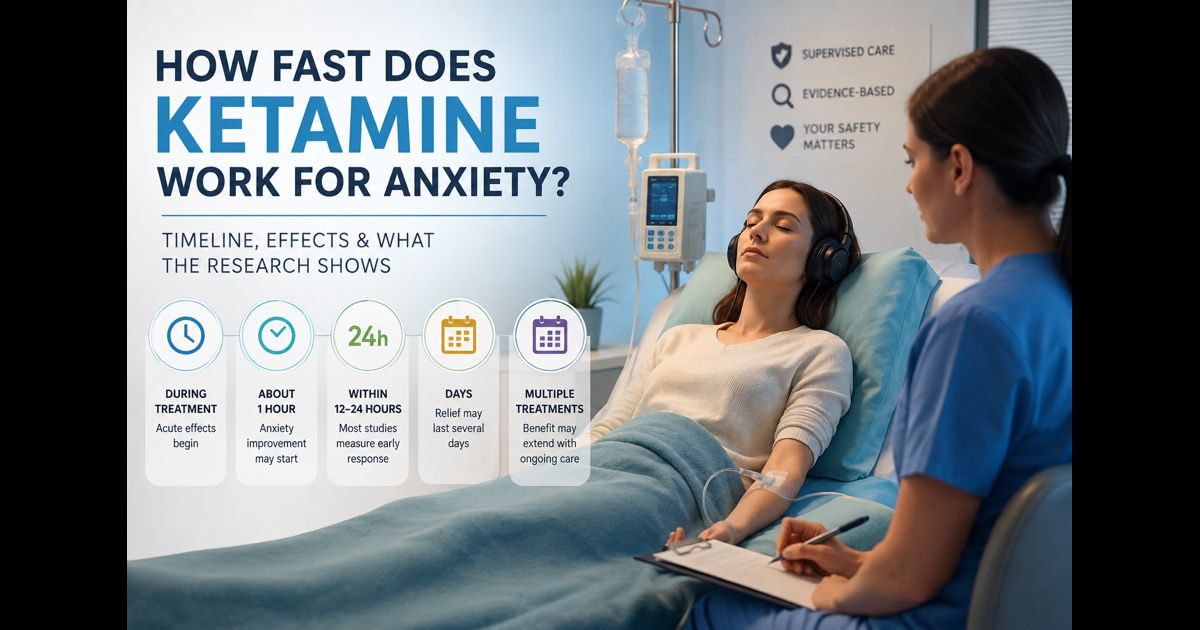
Ketamine may reduce anxiety within hours for some patients, but the most defensible anxiety-specific evidence places the earliest measurable improvement at about one hour after supervised dosing. Broader studies often assess benefit within 12 to 24 hours. Response time, strength and duration vary, and some patients receive no meaningful benefit.
That speed is one reason ketamine has attracted attention for severe or treatment-resistant symptoms. It does not mean that every person feels better during the treatment session, that all forms work at the same rate, or that a rapid change will last.
The Practical Timeline
A medically supervised ketamine session can involve several different stages. Keeping them separate prevents a temporary drug effect from being mistaken for therapeutic progress.
During administration
IV ketamine enters the bloodstream quickly. A person may notice dizziness, altered perception, sedation or detachment while an infusion is underway. These are acute drug effects, not reliable evidence that an anxiety disorder has responded.
Other formulations are absorbed differently, so the onset of noticeable physical or perceptual effects may be less predictable. Dose, route, food intake, metabolism and other medicines can all affect the experience.
About one hour after dosing
Small clinical studies in people with treatment-refractory generalized or social anxiety have detected lower anxiety ratings within approximately one hour. A dose-ranging study reported improvement beginning within an hour and persisting for as long as one week in some participants. However, these findings came from a small research population and should not be presented as an expected result for everyone.
The distinction matters: a study can detect an average change across a group even when some individuals improve substantially, some improve only slightly and others do not respond.
Within the first 12 to 24 hours
Across clinical studies involving anxiety symptoms, the first day is a common period for assessing early response. A transdiagnostic systematic review and meta-analysis found significant reductions in anxiety during the first 12 hours and at 24 hours, with benefits persisting at later assessments in some studies.
This broader evidence includes participants with different diagnoses. It does not establish an identical timeline for generalized anxiety disorder, social anxiety disorder, post-traumatic stress disorder, obsessive-compulsive disorder or anxiety occurring alongside depression.
Over the following days
When ketamine helps, improvement may continue for several days. A person might notice less persistent worry, reduced avoidance, greater tolerance of previously distressing situations or improved ability to complete ordinary activities.
Symptoms can also return. After a single dose, relief in small refractory-anxiety studies has sometimes lasted up to seven days. Other studies have reported effects at one or two weeks, but duration varies considerably and long-term anxiety data remain limited.
After several treatments
Some clinicians use a series of treatments rather than judging the outcome from one dose. Repeated dosing may extend benefit for selected patients, but there is no universally established ketamine schedule for anxiety disorders.
A treatment plan should include predefined goals and regular review. Continuing merely because a person felt unusual during a session is not a sound measure of success.
What Does “Working” Actually Mean?
A meaningful response is more than feeling calm, sleepy or disconnected for a short period. Clinicians may look for changes such as:
- Lower scores on a validated anxiety scale.
- Less uncontrollable worry or anticipatory fear.
- Fewer panic episodes or less severe episodes.
- Reduced avoidance of work, travel or social situations.
- Better sleep, concentration or day-to-day functioning.
- An improvement that remains after acute drug effects have ended.
Personal observations matter, but consistent measurement provides a clearer picture. Recording symptoms before treatment and at agreed intervals afterward helps distinguish sustained benefit from expectation, sedation or a temporary change in mood.
Why Response Time Varies
There is no exact countdown that applies to every patient. Several factors can alter both the likelihood and timing of improvement.
The anxiety condition being treated
Evidence is not equally strong across diagnoses. Randomized trials have examined social anxiety disorder, PTSD and OCD, while generalized anxiety research includes small dose-ranging and maintenance studies. Results from one condition cannot automatically be applied to another.
PTSD and OCD are also classified separately from anxiety disorders in current diagnostic systems, even though anxiety may be a major part of both.
Route of administration
IV infusion has been studied more directly in small anxiety trials and provides controlled delivery. Subcutaneous and intramuscular ketamine have appeared in limited refractory-anxiety research. Oral and sublingual formulations have different absorption and variable bioavailability, so an IV timeline should not be copied directly to them.
Intranasal esketamine is a specific prescription product, not simply another name for an ordinary ketamine nasal spray.
Dose and treatment protocol
Some anxiety research has shown a dose-response pattern: higher studied doses produced greater average symptom reductions but also increased dissociative effects and changes in blood pressure or heart rate. This does not mean a higher dose is automatically better or appropriate. Dose selection requires clinical assessment and monitoring.
Other health conditions and medicines
Cardiovascular health, substance-use history, pregnancy, psychosis risk, liver or urinary problems and concurrent medicines can affect whether treatment is appropriate. Sedatives and other central nervous system depressants may also change safety risks and the treatment experience.
Expectations and symptom measurement
An intense or unusual session can create an expectation of improvement. Conversely, someone may overlook a genuine functional change because it does not feel dramatic. Reviewing specific symptoms and daily activities is more informative than asking only whether the treatment “felt strong.”
Ketamine and Esketamine Are Not the Same Treatment
Racemic ketamine contains two mirror-image forms of the molecule and is FDA-approved as an anesthetic. When prescribed for anxiety or another psychiatric condition, its use is off-label. The FDA confirms that ketamine itself is not approved for psychiatric treatment in the United States.
Esketamine contains one form of the molecule and is marketed as Spravato. Its current U.S. labeling covers treatment-resistant depression in adults, either alone or with an oral antidepressant, and depressive symptoms in adults with major depressive disorder accompanied by acute suicidal ideation or behavior when used with an oral antidepressant. It is not FDA-approved specifically for an anxiety disorder.
Spravato must be administered under a regulated safety program in a certified healthcare setting. Patients are observed because of risks including sedation, dissociation, respiratory depression and changes in blood pressure.
Calling all nasal products “Spravato” is inaccurate. Compounded nasal ketamine and FDA-approved esketamine differ in formulation, regulatory review and supervision requirements.
How Strong Is the Evidence for Anxiety?
Research is promising but preliminary.
A systematic review of refractory anxiety disorders found six eligible acute randomized controlled trials: two involving social anxiety disorder, three involving PTSD and one involving OCD. Four reported significant improvement on anxiety-rating measures compared with a control. The authors emphasized small samples, limited long-term data and uncertainty about off-label use and abuse risk.
A later review reported rapid reductions in anxiety symptoms, including changes within one hour in some studies. It also concluded that the evidence was limited by small study sizes and inconsistent methods.
These limitations do not mean ketamine cannot help. They mean the answer must remain conditional. Strong results in treatment-resistant depression cannot be treated as direct proof of equal effectiveness for primary anxiety disorders.
How Long Can Relief Last?
Following one supervised treatment, relief may last several days and occasionally longer. In small refractory-anxiety studies, improvements have persisted for up to one week. Reviews covering mixed clinical populations have identified benefits at seven to fourteen days in some datasets.
No single duration should be promised. The outcome may be:
- No measurable response.
- Brief improvement followed by symptom return.
- Increasing improvement during the first day.
- Benefit lasting several days.
- A response that is maintained only with further treatment.
- Longer improvement when ketamine is combined with appropriate psychotherapy and continuing care.
Ketamine should not replace an effective long-term plan without a clinical reason. Therapy, established medications, sleep care, physical activity and reduction of alcohol or stimulant use may still be important. Practical guidance for managing anxiety can support ongoing care, although persistent or disabling symptoms warrant evaluation by a qualified mental-health professional.
What If Nothing Changes After the First Treatment?
A lack of improvement within hours does not by itself establish permanent nonresponse. The clinician should consider the route, dose, diagnosis, symptom measurements, other medicines and intended protocol.
At the same time, repeated treatment should have a clear clinical rationale. Before starting, patients can ask:
- Which anxiety diagnosis is being treated?
- What evidence supports this particular formulation and route?
- When will symptoms be measured?
- What degree of improvement will count as a response?
- How many sessions will occur before the plan is reconsidered?
- What is the strategy if the benefit lasts only a few days?
- Who manages side effects or worsening symptoms between sessions?
If a planned trial produces no meaningful functional or symptom improvement, continuing indefinitely exposes the patient to cost and risk without demonstrated benefit.
Safety Requires Medical Screening and Monitoring
Ketamine can cause dissociation, sedation, dizziness, nausea, perceptual changes and temporary increases in blood pressure. Less common concerns include respiratory problems, cognitive effects, liver or urinary injury with repeated exposure, misuse and dependence.
The FDA has specifically warned about compounded ketamine used for psychiatric conditions, particularly when oral products are obtained through telemedicine and taken without onsite monitoring. Compounded medicines do not undergo the same premarket review for safety, effectiveness and quality as FDA-approved products.
Ketamine should never be purchased from an unverified online seller, taken without a prescription or combined independently with alcohol, opioids, benzodiazepines or other sedating substances. Patients should disclose all medicines and substance use to the prescriber.
Someone experiencing suicidal thoughts, inability to remain safe, severe agitation or a psychiatric crisis should seek immediate emergency help. Ketamine is not a home rescue treatment for an acute crisis.
Questions Patients Commonly Ask
Can ketamine reduce anxiety immediately?
Physical or perceptual effects can begin quickly, particularly with IV administration. Measurable anxiety improvement has appeared at about one hour in small studies, but immediate relief is not guaranteed.
Is one ketamine treatment enough?
Some participants have improved after one dose, with benefits lasting several days. Others require further treatment or do not respond. One session cannot reliably predict durable remission for every patient.
Does IV ketamine work faster than oral ketamine?
IV delivery places ketamine directly into the bloodstream and has a more controlled onset. Oral and sublingual absorption is slower and more variable. Direct anxiety-specific comparisons between routes remain limited.
Is Spravato approved for anxiety?
No. Spravato is FDA-approved for specified depressive conditions, not for an anxiety disorder. Racemic ketamine used for anxiety is also an off-label psychiatric treatment.
Can ketamine make anxiety worse?
Yes. Anxiety, agitation, disorientation or distress can occur during or after treatment. Appropriate screening, a controlled setting and professional monitoring reduce but do not eliminate these risks.
Final Thoughts
Ketamine can act faster than standard long-term anxiety medicines for some patients, but “fast” should be interpreted carefully. The strongest anxiety-specific evidence supports possible improvement beginning around one hour after supervised dosing, while many studies evaluate the response over the first 12 to 24 hours.
The evidence is most relevant to selected patients with severe or treatment-refractory symptoms and remains much smaller than the evidence base for depression. A trustworthy treatment decision therefore depends on an accurate diagnosis, careful screening, supervised administration, objective follow-up and an honest discussion of what is known—and what remains uncertain.