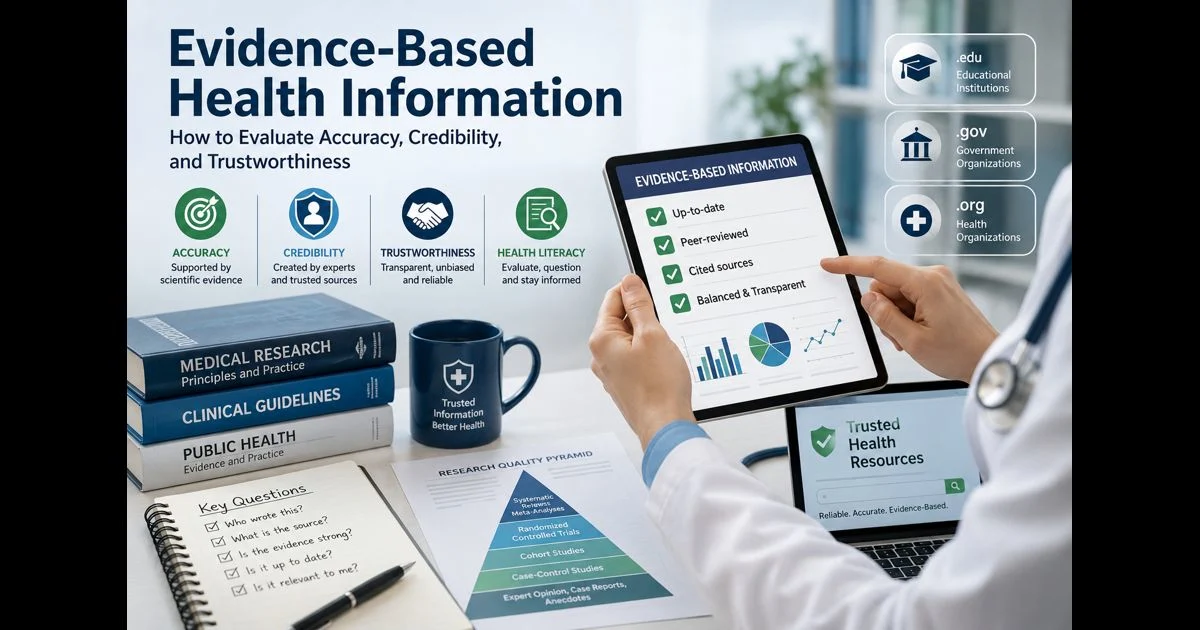
Introduction
Every day, people turn to the internet with questions about their health. Some are trying to understand a new diagnosis, while others want to compare treatment options, learn about healthy habits, or decide whether a symptom requires medical attention. Within seconds, search engines and social media provide thousands of articles, videos, blog posts, and opinions. Although this easy access to information is valuable, it also creates a new challenge: knowing which information can actually be trusted.
Not everything published online is supported by reliable scientific evidence. Some content is carefully researched and reviewed by medical professionals, while other information may be outdated, misleading, or written primarily to attract clicks rather than educate readers. Inaccurate health advice can lead to unnecessary anxiety, poor health decisions, delayed treatment, or false confidence in unproven remedies.
For that reason, learning how to evaluate health information has become an essential life skill. You do not need a medical degree to recognize reliable health resources. By understanding how evidence is produced, how scientific recommendations evolve, and how trustworthy sources present information, you can make more informed decisions about your health.
At Health Threetrees Com VN, we believe that improving health literacy starts with helping readers understand not only what health information says, but also why it deserves trust. This guide explains the principles behind evidence-based health information and offers practical ways to evaluate the quality of the health advice you encounter online.
Why Evidence-Based Health Information Matters
Access to health information has never been greater. Unfortunately, neither has the spread of misinformation.
Health-related claims can travel across social media within minutes. A short video, an eye-catching headline, or a personal success story may reach millions of people before experts have an opportunity to examine whether the claims are supported by scientific research.
This creates an important question for every reader:
How can you tell whether a health claim is based on evidence or simply someone’s opinion?
The answer usually depends on several factors working together rather than one single sign. Reliable health information is typically supported by quality research, reviewed by qualified experts, presented transparently, and consistent with findings from multiple independent studies.
Developing the ability to recognize these characteristics helps people avoid misinformation while making better decisions about prevention, treatment, nutrition, and overall well-being.
What Does “Evidence-Based” Actually Mean?
The phrase evidence-based is widely used in healthcare, but it is often misunderstood.
Evidence-based health information combines three important elements:
- High-quality scientific research.
- Clinical expertise from qualified healthcare professionals.
- Individual patient needs, preferences, and circumstances.
This approach recognizes that healthcare is rarely based on one study or one expert’s opinion alone. Instead, recommendations are developed by examining the best available scientific evidence while considering real-world patient care.
As new research becomes available, recommendations may change. Rather than indicating weakness, this reflects the strength of science—it continually improves as better evidence emerges.
Understanding How Scientific Evidence Is Built
Many people assume that a single published study provides definitive answers. In reality, scientific knowledge develops gradually.
Researchers begin with observations or questions, design studies to test their ideas, analyze the results, and publish their findings for independent evaluation. Other researchers may repeat similar studies using different participants, methods, or locations.
Over time, patterns begin to emerge.
When multiple well-designed studies consistently produce similar results, confidence in those findings increases. If later research produces different results, recommendations may be updated to reflect the stronger evidence.
This gradual process explains why health guidance sometimes changes. Science is not changing its mind without reason—it is improving its understanding.
Why Personal Experiences Are Not Enough
Personal experiences can be helpful because they show how individuals respond to certain treatments or lifestyle changes. Many people discover useful strategies through their own experiences.
However, individual stories cannot establish whether something works for everyone.
For example, one person may report significant improvements after following a particular diet, taking a supplement, or trying a specific exercise routine. Another individual following exactly the same approach may experience little or no benefit.
Differences in genetics, age, medical history, medications, lifestyle, sleep, stress, and environmental factors all influence health outcomes.
Evidence-based healthcare looks beyond individual experiences by asking broader questions:
- Has this outcome been observed in large groups of people?
- Have multiple researchers reached similar conclusions?
- Can the findings be reproduced under different conditions?
- Do experts reviewing the evidence agree with the conclusions?
These questions help distinguish reliable evidence from isolated experiences.
Recognizing Reliable Sources of Health Information
The source of information often reveals as much as the information itself.
Reliable health resources typically explain where their recommendations come from and reference scientific research or established clinical guidelines.
Examples of trustworthy sources include:
- National public health agencies.
- Medical universities.
- Professional healthcare organizations.
- Peer-reviewed medical journals.
- Hospitals and academic medical centers.
Reliable educational websites usually identify their authors, explain editorial standards, update content when new evidence becomes available, and distinguish clearly between facts, expert opinions, and emerging research.
By contrast, websites relying primarily on anonymous claims, testimonials, sensational headlines, or product marketing deserve greater caution.
How to Evaluate Accuracy
Accuracy means the information reflects the best available scientific understanding at the time it was published.
When reading a health article, ask yourself:
- Are scientific sources or medical guidelines referenced?
- Does the information match recommendations from respected health organizations?
- Is the publication date recent enough for the topic?
- Are statistics presented with appropriate context?
- Does the article acknowledge limitations where appropriate?
Accurate health education rarely promises certainty in every situation. Instead, it explains what current research shows while recognizing where additional evidence is still needed.
Evaluating Credibility
Credibility relates to the expertise behind the information.
Consider questions such as:
- Who wrote the article?
- Are the author’s qualifications clearly identified?
- Does the website explain its editorial review process?
- Is the organization known for providing health education rather than primarily selling products?
Expertise alone does not automatically guarantee accuracy, but transparent authorship and professional accountability significantly increase confidence in the information presented.
Trustworthiness: Looking Beyond the Surface
Trustworthiness is slightly different from accuracy and credibility. A source can appear professional but still present information in a misleading way. Trustworthy health resources are transparent about how their content is created, reviewed, and updated.
Some characteristics of trustworthy health information include:
- Clear authorship and editorial policies.
- Regular content reviews and updates.
- References to established scientific evidence.
- Balanced discussion of both benefits and risks.
- Disclosure of sponsorships or potential conflicts of interest.
Trustworthy websites also avoid making health decisions for readers. Instead, they explain the evidence and encourage informed discussions with qualified healthcare professionals when appropriate.
Why Scientific Recommendations Sometimes Change
One of the biggest misunderstandings about science is the belief that changing recommendations mean earlier advice was completely wrong.
In reality, science is a process of continuous improvement.
Researchers constantly gather new evidence, repeat experiments, compare findings, and refine their understanding. As stronger evidence becomes available, medical recommendations naturally evolve.
Nutrition provides a good example. Over the past few decades, recommendations regarding dietary fats, cholesterol, sugar, sodium, and eating patterns have changed as larger and better-designed studies produced clearer evidence.
Rather than reducing trust in science, these updates demonstrate its greatest strength: the willingness to improve when better evidence becomes available.
Readers should therefore avoid assuming that changing recommendations automatically indicate inconsistency. More often, they reflect increasing scientific knowledge.
Why Headlines Can Be Misleading
Health headlines are designed to attract attention.
Unfortunately, headlines often simplify complex research into a single sentence that leaves out important context.
Consider a headline such as:
“A Popular Food Cuts Heart Disease Risk.”
At first glance, the statement sounds convincing. However, responsible readers should ask additional questions.
- Was the research conducted on humans or animals?
- How many people participated?
- Was the study observational or experimental?
- Was the effect large or relatively small?
- Have other researchers reached similar conclusions?
Without this context, readers may misunderstand the significance of the findings.
Responsible health reporting explains both the strengths and limitations of new research instead of presenting every study as a major breakthrough.
Correlation Does Not Always Mean Causation
Health news frequently reports relationships between different lifestyle factors and medical conditions. However, identifying a relationship does not necessarily prove that one factor caused the other.
Suppose researchers observe that people who exercise regularly experience fewer heart problems.
Exercise may certainly contribute to better cardiovascular health, but those individuals might also:
- Eat more nutritious foods.
- Sleep longer.
- Smoke less.
- Receive preventive healthcare.
- Maintain healthier body weight.
Many lifestyle factors influence health simultaneously.
High-quality research attempts to account for these variables before concluding that one factor directly causes another.
Whenever you encounter claims that a single habit “prevents,” “cures,” or “causes” a health condition, it is worth examining whether the evidence truly supports that conclusion.
Why Peer Review Matters
Before many scientific studies are published, they undergo a process called peer review.
During this process, independent experts working in the same field evaluate the research methods, statistical analysis, interpretation of results, and overall quality of the study.
Peer review does not guarantee perfection. Researchers may still identify limitations or publish updated findings later.
However, peer review helps improve research quality by identifying weaknesses before publication and encouraging higher scientific standards.
Articles supported by peer-reviewed research generally deserve greater confidence than content based solely on opinions, marketing claims, or unpublished observations.
One Study Rarely Changes Medical Practice
News reports sometimes give the impression that every newly published study completely changes medical knowledge.
That rarely happens.
Healthcare recommendations are usually based on the collective findings of many independent studies conducted over several years.
Researchers place greater confidence in evidence when:
- Multiple studies produce similar results.
- Different research teams reach comparable conclusions.
- Findings remain consistent across different populations.
- Systematic reviews confirm the overall evidence.
This explains why systematic reviews and meta-analyses often carry more weight than individual studies. They evaluate the complete body of available evidence rather than relying on one isolated investigation.
Separating Evidence From Opinion
Opinions remain valuable in healthcare.
Doctors, nurses, researchers, dietitians, and patients all contribute important perspectives based on their professional experience or personal journey.
However, opinions should not be mistaken for scientific evidence.
Reliable health education clearly distinguishes between:
- Established scientific findings.
- Professional interpretation.
- Personal experiences.
- Emerging research.
Understanding these differences allows readers to appreciate expert insight without confusing individual opinions with proven scientific conclusions.
Recognizing Commercial Influence
Many health websites also promote products or services.
Selling products does not automatically make information unreliable, but commercial interests can influence how evidence is presented.
When reading health content, ask yourself:
- Is the primary goal education or marketing?
- Are both advantages and disadvantages discussed?
- Does the article acknowledge situations where the product may not be appropriate?
- Are scientific references provided to support the claims?
Balanced educational resources discuss realistic expectations rather than presenting products as universal solutions.
Beware of Absolute Claims
Science rarely deals in absolutes.
Reliable experts often use language such as:
- “Current evidence suggests…”
- “Research indicates…”
- “May reduce the risk…”
- “Further studies are needed…”
These phrases reflect scientific honesty rather than uncertainty.
By contrast, statements like these deserve careful scrutiny:
- “Guaranteed cure.”
- “Works for everyone.”
- “Doctors don’t want you to know this.”
- “The only treatment you’ll ever need.”
Extraordinary claims require equally strong evidence.
Whenever an article relies on dramatic promises instead of carefully explaining the evidence, readers should approach the information with caution.
Becoming a More Confident Reader of Health Information
Learning to evaluate health information does not mean becoming suspicious of every article you read. Instead, it means developing the habit of asking thoughtful questions before accepting a health claim as fact.
Whenever you come across new medical advice, pause for a moment and consider:
- Who created this information?
- What evidence supports the claim?
- Is the information current?
- Are the limitations explained?
- Does it agree with recommendations from other trusted organizations?
These questions take only a few moments to answer, but they can dramatically improve your ability to distinguish reliable guidance from misinformation.
Over time, critical evaluation becomes a habit rather than a deliberate process.
Building Health Literacy Over Time
Health literacy is more than the ability to read medical information. It is the ability to understand health concepts, evaluate different sources of information, and apply reliable knowledge when making decisions.
Strong health literacy develops gradually through experience. Reading trustworthy educational resources, asking healthcare professionals informed questions, and staying open to new scientific evidence all contribute to better understanding.
People with strong health literacy are generally better prepared to:
- Understand medical recommendations.
- Manage chronic health conditions.
- Compare treatment options.
- Recognize misleading claims.
- Communicate effectively with healthcare providers.
Health literacy is not about memorizing medical facts. It is about learning how to think critically whenever health information is presented.
The Growing Importance of Digital Health Literacy
The internet has transformed digital health education by making medical knowledge more accessible than ever before. Educational websites, podcasts, online seminars, and mobile applications now help people access reliable health information more easily.
While this accessibility offers enormous benefits, it also increases the need for digital health literacy.
Digital health literacy involves knowing how to search effectively, evaluate online sources, recognize misleading content, and understand the difference between educational information and promotional material.
Before sharing a health article or following online advice, ask yourself:
- Does this information come from a reputable organization?
- Is the article supported by scientific evidence?
- Is the content trying to educate or persuade?
- Does the headline accurately represent the research?
These habits reduce the likelihood of spreading misinformation and improve the quality of health decisions made online.
Understanding Confirmation Bias
Human psychology influences how everyone interprets information.
One of the most common cognitive biases is confirmation bias—the tendency to notice information that supports existing beliefs while ignoring evidence that challenges them.
For example, someone who strongly believes in a particular diet may pay attention only to articles highlighting its benefits while overlooking research discussing its limitations.
Healthcare professionals and researchers actively work to minimize these biases through structured research methods, peer review, and independent replication.
Readers can also reduce confirmation bias by intentionally seeking information from multiple trusted sources instead of relying on a single article or social media post.
Being willing to reconsider your opinion when stronger evidence becomes available is a sign of critical thinking, not weakness.
Practical Questions to Ask Before Trusting Any Health Claim
Whenever you encounter new health information online, consider using this simple evaluation framework.
1. Who published the information?
Reliable organizations are transparent about their mission, editorial process, and contributors.
2. Who wrote it?
Look for identifiable authors with relevant medical, scientific, or healthcare expertise.
3. Where does the evidence come from?
High-quality health articles usually reference scientific studies, clinical guidelines, or recommendations from recognized professional organizations.
4. Is the information current?
Medicine changes over time. Publication dates and recent updates matter, particularly for rapidly evolving topics.
5. Is the language balanced?
Trustworthy educational content explains both potential benefits and possible limitations instead of promising guaranteed outcomes.
6. Does the article acknowledge uncertainty?
Good health education recognizes that not every question has a simple answer. Honest discussion of uncertainty is often a sign of reliable communication.
7. Have other reputable sources reached similar conclusions?
One article should rarely be the basis for important health decisions. Comparing information across multiple trusted organizations provides greater confidence.
Common Warning Signs of Low-Quality Health Information
Not every inaccurate article is intentionally misleading, but certain warning signs should encourage readers to investigate further.
Be cautious if you notice:
- Claims of instant or guaranteed cures.
- Headlines designed primarily to shock or create fear.
- Heavy reliance on personal testimonials without scientific evidence.
- Anonymous authors or missing credentials.
- Lack of references to credible research.
- Articles that promote products while ignoring risks or limitations.
- Statements suggesting that all medical experts are hiding “the truth.”
Reliable health education generally avoids sensational language because science rarely supports absolute certainty.
Why Responsible Health Communication Matters
Good health communication is not simply about sharing facts.
It also involves presenting evidence in ways that readers can understand without oversimplifying complex topics.
Responsible educational resources explain:
- What researchers know.
- What remains uncertain.
- How conclusions were reached.
- Why recommendations may evolve as new evidence becomes available.
This balanced approach helps readers develop confidence based on understanding rather than emotion or popularity.
It also strengthens trust between healthcare professionals, researchers, and the public.
Final Thoughts
Access to health information has become easier than ever, but access alone is not enough. The ability to evaluate accuracy, credibility, and trustworthiness is now an essential part of making informed health decisions.
Evidence-based health information is built through careful research, independent review, transparency, and continuous learning. It rarely offers simple answers to complex questions, yet it provides the strongest foundation for understanding health, preventing disease, and improving well-being.
At Health Threetrees Com VN, our goal is to help readers become informed participants in their own healthcare by promoting reliable, balanced, and evidence-based education. Developing the habit of questioning sources, examining evidence, and comparing information across trusted organizations not only improves health literacy but also supports better decisions throughout life.
The more carefully we evaluate health information today, the more confident and informed our health choices will be in the future.
Frequently Asked Questions
What is evidence-based health information?
Evidence-based health information combines the best available scientific research with clinical expertise and individual patient circumstances. It reflects current medical knowledge and is updated as stronger evidence becomes available.
Why should I evaluate health information before trusting it?
Evaluating health information helps reduce the risk of acting on inaccurate, misleading, or outdated advice. Reliable information supports better healthcare decisions and encourages productive conversations with qualified medical professionals.
How can I identify a trustworthy health website?
Look for transparent authorship, references to scientific research, clear editorial standards, regular content updates, and information that aligns with guidance from recognized healthcare organizations.
Why do medical recommendations sometimes change?
As researchers conduct better studies and collect more evidence, scientific understanding improves. Updated recommendations reflect stronger knowledge rather than inconsistency.
Are personal experiences considered scientific evidence?
Personal experiences can provide useful insights, but they cannot demonstrate whether a treatment or health practice works consistently across larger populations. Reliable recommendations depend on carefully conducted scientific research involving many participants.
What is the easiest way to evaluate a health claim?
Start by asking who published the information, whether scientific evidence supports it, if the content is current, whether it presents balanced information, and whether multiple trusted organizations reach similar conclusions. These simple questions can help you separate reliable health education from misinformation.