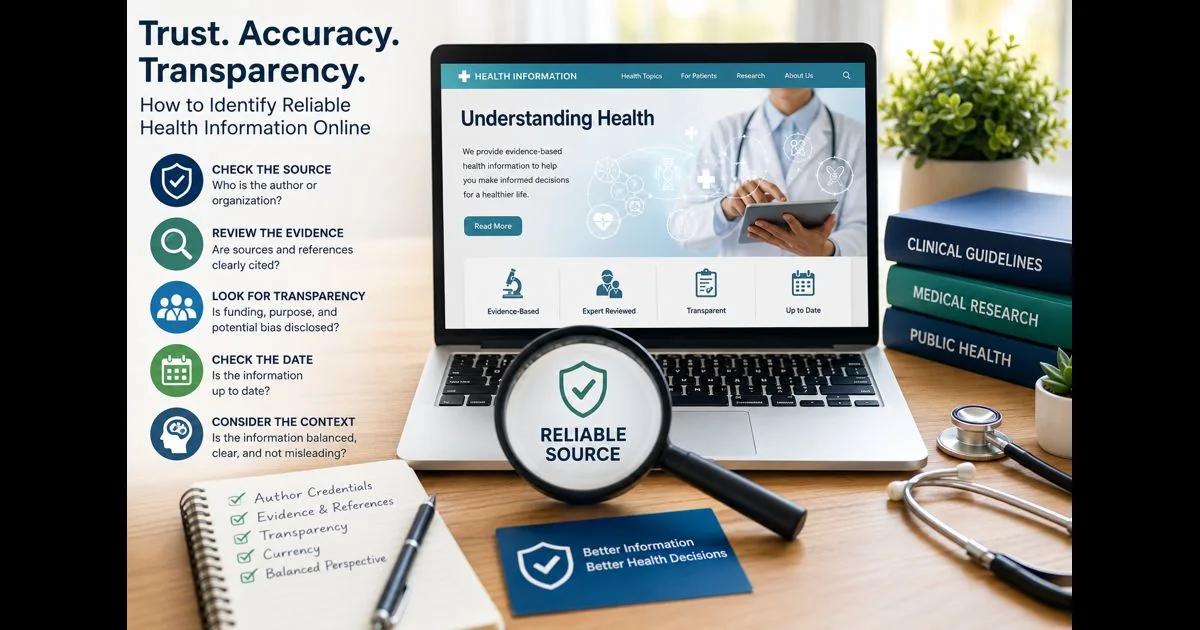
Most people today do not struggle to find health information. The real challenge is deciding which information can be trusted.
With a few clicks, anyone can access thousands of articles, videos, and social media posts about almost any health topic. Some of this information is helpful and evidence-based. Some of it is incomplete, misleading, or based on personal opinion rather than scientific understanding. Much of it sits somewhere in between, mixing facts with interpretation in ways that are not always easy to separate.
This creates a simple but important question for readers:
How do you know if an online health source is actually reliable?
Understanding trust, accuracy, and transparency is not about becoming skeptical of everything. It is about developing the ability to recognize which sources are built on evidence and which ones rely on assumptions, marketing, or oversimplification.
At Health Threetrees Com VN, we focus on helping readers build this kind of clarity. Good health decisions depend not only on what information you find, but also on how you evaluate the quality of that information.
Why Trust Matters in Health Information
Trust plays a central role in how people interpret health content.
When a source appears credible, readers are more likely to accept its advice without question. When a source feels uncertain or confusing, people may ignore useful information entirely. Both situations can lead to poor decisions if trust is not based on careful evaluation.
In health topics, this becomes even more important because decisions can directly affect physical and mental well-being.
Trustworthy health information should help readers understand not just what they should know, but why that information is considered reliable.
Without that context, even correct information can be misunderstood or misapplied.
Accuracy Is Not Just About Being “Right”
Accuracy in health information is often misunderstood as simply being correct or incorrect. In reality, it is more complex.
Health knowledge is built through ongoing research, and scientific understanding evolves over time. What is considered accurate today may be refined later as new studies become available.
This does not mean science is unreliable. It means science is self-correcting.
Accurate health information usually reflects:
- Current scientific evidence
- Consensus among experts
- Clearly stated limitations
- Acknowledgment of uncertainty where it exists
A source that presents health information as absolute truth without context is often less reliable than one that explains what is known and what is still being studied.
Transparency Builds Confidence
Transparency is one of the strongest indicators of a reliable health source.
It refers to how openly a source explains where its information comes from and how it is developed.
Transparent health information usually includes:
- Clear identification of authors or contributors
- Explanation of evidence sources (such as research studies or clinical guidelines)
- Disclosure of potential conflicts of interest
- Updates when new evidence becomes available
When this information is missing, it becomes difficult to judge how the content was created or whether it reflects unbiased evidence.
Transparency does not guarantee perfection, but it significantly improves trustworthiness.
The Difference Between Information and Interpretation
One of the most important skills in evaluating online health content is recognizing the difference between raw information and interpretation.
Information refers to research findings, clinical data, or established medical knowledge.
Interpretation refers to how someone explains or applies that information.
Two sources can use the same study but present different interpretations based on tone, intent, or perspective. One may focus on limitations while another emphasizes potential benefits. Neither is automatically wrong, but the framing can significantly influence how readers understand the message.
Learning to separate evidence from interpretation helps reduce confusion and improves decision-making.
Why Online Health Content Often Feels Confusing
Many readers feel overwhelmed when searching for health information online. This is not because information is unavailable, but because it is inconsistent.
Different sources may present conflicting recommendations. Some articles focus on early research findings, while others rely on outdated information or simplified summaries. Social media adds another layer by prioritizing engagement over accuracy.
As a result, readers are often left trying to make sense of multiple viewpoints without clear guidance on which sources are most reliable.
This is where a structured evaluation framework becomes useful. Instead of relying on intuition alone, readers can assess information based on specific qualities such as credibility, evidence, and transparency.
Evaluating the Source Behind the Information
One of the most practical ways to judge online health content is to look at the source itself, not just the message it is delivering.
Reliable health information usually comes from organizations or individuals with a clear connection to healthcare, research, or public health education. This may include hospitals, universities, public health agencies, or qualified medical professionals who reference established evidence.
However, credibility is not only about titles or affiliations. It is also about how consistently a source demonstrates careful, evidence-informed communication over time.
A useful habit is to ask a simple question:
“Would this source be trusted by healthcare professionals or research communities?”
If the answer is unclear, it often signals the need for deeper evaluation.
How Evidence Is Used in Reliable Health Content
Strong health information does not rely on opinion alone. It is supported by evidence that can be traced back to scientific research.
However, not all evidence carries the same weight.
For example, a single study involving a small group of participants may provide early insights, but it cannot establish broad conclusions. On the other hand, systematic reviews and meta-analyses combine findings from multiple high-quality studies and often provide a more reliable understanding of a topic.
Trustworthy sources usually:
- Reference peer-reviewed research
- Explain study limitations clearly
- Avoid overgeneralizing early findings
- Distinguish between preliminary and established evidence
When evidence is missing or vaguely referenced, readers should approach the information with caution.
Recognizing Bias in Health Information
Bias does not always mean false information. It often refers to subtle influences that shape how information is presented.
One common form is commercial bias, where content is influenced by products, services, or marketing goals. Another is selection bias, where only certain studies or viewpoints are highlighted while others are ignored.
Even well-intentioned content can be affected by bias if it emphasizes one perspective without acknowledging alternatives.
Being aware of bias does not require rejecting information. It simply means reading with awareness that perspective matters.
A balanced health resource typically acknowledges limitations and avoids presenting one-sided conclusions as absolute truth.
The Role of Language in Trustworthiness
The way health information is written often reveals a lot about its reliability.
Credible sources tend to use cautious, precise language such as:
- “Current evidence suggests…”
- “Research indicates…”
- “May be associated with…”
- “Further studies are needed…”
This kind of wording reflects the natural uncertainty present in scientific research.
Less reliable sources often rely on absolute or emotional language, such as:
- “Guaranteed cure”
- “Instant results”
- “Doctors don’t want you to know this”
- “One simple solution for everything”
These phrases are designed to attract attention rather than accurately represent scientific complexity.
Understanding this difference helps readers quickly identify content that may not be based on strong evidence.
Why Transparency About Limits Matters
No health information source has complete certainty. Science is an ongoing process, and new findings can refine or change existing understanding.
Because of this, transparency about limitations is a key sign of credibility.
Reliable sources are open about:
- What is still unknown
- Where research results are mixed
- Which populations may not be represented in studies
- How confident the conclusions actually are
When content avoids these limitations entirely, it may present an overly simplified or misleading picture of reality.
Transparency builds trust because it shows respect for the reader’s ability to understand complexity rather than hiding it.
Cross-Checking Information Across Multiple Sources
One of the simplest ways to evaluate health information is to compare it with other reputable sources.
When multiple independent organizations reach similar conclusions, confidence in that information increases. When significant differences appear, it often signals that the topic is still evolving or that interpretation varies between sources.
Cross-checking does not require technical expertise. It only requires attention to consistency.
If reliable health organizations consistently present similar guidance, that alignment is usually a strong indicator of accuracy.
Why Context Changes Everything
Health information cannot always be understood in isolation. Context plays a major role in determining whether advice is appropriate.
For example, recommendations for physical activity may differ depending on age, medical history, or existing conditions. Nutritional guidance may also vary based on individual needs, lifestyle, and cultural factors.
This is why general health content should never replace personalized medical advice.
Reliable sources make this distinction clear by encouraging readers to consult healthcare professionals when appropriate and by avoiding one-size-fits-all claims.
Understanding context helps prevent misinterpretation and supports safer decision-making.
A Practical Framework for Evaluating Online Health Information
When reading health content online, it helps to move beyond intuition and use a simple, structured way of thinking. Instead of asking only “Does this sound right?”, it is more useful to evaluate information through a few consistent checks.
A reliable piece of health information usually performs well across several areas at the same time:
It comes from a clearly identifiable source with relevant expertise or institutional backing.
It explains where its information originates, ideally linking or referring to scientific research or recognized health authorities.
It presents information in a balanced way, without exaggeration or one-sided conclusions.
It acknowledges limitations and avoids presenting early findings as final truth.
When these elements are present together, confidence in the information naturally increases.
On the other hand, when sources are anonymous, overly promotional, or vague about evidence, it becomes harder to judge reliability.
This framework is not meant to create doubt about everything you read. It is meant to create clarity about what deserves greater attention.
Trust Is Built Through Consistency, Not Single Claims
One of the most important ideas in evaluating health information is that trust is not based on a single article or claim.
Instead, trust is built over time through consistent behavior.
A reliable source does not just publish one accurate piece of content. It repeatedly demonstrates careful use of evidence, transparent communication, and responsible interpretation of research.
This is why established health organizations and academic institutions are often considered more reliable. Their credibility is based on long-term patterns, not isolated statements.
For readers, this means that evaluation should not stop at one page. It is often helpful to look at how a source handles multiple topics over time.
When Health Information Feels Conflicting
It is very common to find different answers to the same health question online. This can feel confusing, but it is often a natural result of how science works.
Some studies are conducted in different populations. Others use different methods or measure different outcomes. New research may refine or challenge earlier findings.
Because of this, disagreement between sources does not automatically mean someone is wrong. It often reflects the evolving nature of medical knowledge.
In these situations, the most reliable approach is to look for broader patterns rather than focusing on isolated claims.
When multiple high-quality sources gradually move toward similar conclusions, those patterns become more meaningful than any single article.
Why Critical Reading Skills Matter More Than Ever
The volume of health information available today is growing faster than most people can reasonably process.
Search engines, social media platforms, and content websites all compete for attention, which often leads to simplified messaging or attention-grabbing headlines.
In this environment, critical reading becomes an essential skill rather than an optional one.
Critical reading does not mean rejecting information. It means slowing down enough to understand what is being claimed, what evidence supports it, and how confident the source actually is.
This approach reduces the risk of misunderstanding and helps readers make more informed decisions in daily life.
The Role of Responsible Health Communication
While readers play an important role in evaluating information, content creators also carry responsibility.
Responsible health communication focuses on clarity, honesty, and context. It avoids unnecessary alarm, does not overstate certainty, and clearly separates evidence from interpretation.
It also recognizes that health information is not just about facts, but about how those facts are understood by real people making real decisions.
When information is communicated responsibly, it becomes easier for readers to apply it appropriately without confusion or misinterpretation.
Final Thoughts
Evaluating trust, accuracy, and transparency in online health information is not about finding perfect sources. It is about learning to recognize patterns of reliability.
No single rule can guarantee that every piece of information is correct. However, by paying attention to evidence, language, transparency, and consistency, readers can significantly improve their ability to judge what is trustworthy.
Over time, this skill becomes less about checking boxes and more about developing an instinct for quality.
At Health Threetrees Com VN, we encourage readers to approach health information with both openness and awareness. The goal is not to doubt everything, but to understand enough to make confident and informed decisions.
In a world where health content is abundant but not always consistent, the ability to evaluate information carefully is one of the most valuable health skills a person can develop.
Frequently Asked Questions
What is the most important factor in judging health information online?
There is no single factor, but evidence quality, source credibility, transparency, and balanced presentation all work together to determine reliability.
Why do different health websites give different answers?
Differences often arise from varying research methods, study populations, or interpretation of evidence. Science is also constantly evolving, which can lead to updated or revised recommendations.
How can I quickly check if a health website is trustworthy?
Look for clear authorship, references to scientific research, balanced explanations, and transparency about limitations or uncertainty. Avoid sources that rely heavily on sensational or absolute claims.
Is it safe to rely on social media for health advice?
Social media can provide useful awareness, but it is not always reliable for detailed health guidance. Information should be cross-checked with credible medical or scientific sources.
Why is transparency important in health information?
Transparency helps readers understand where information comes from, how it was developed, and how confident they should be in the conclusions. It builds trust and reduces misunderstanding.